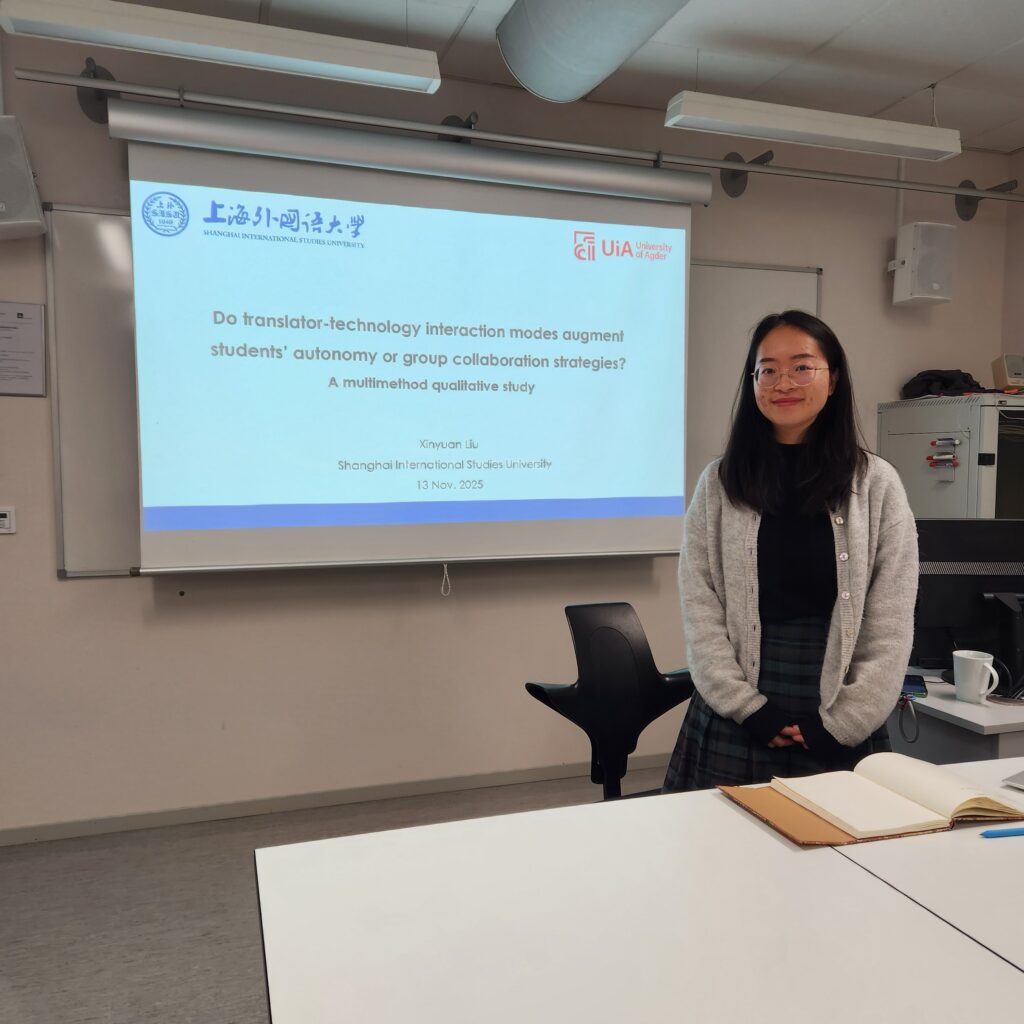
On the 13th of November, Xinyuan Liu was invited by Professor Eli-Marie Danbolt Drange, the group leader of the Multilingualism in Society and Education at UiA, to deliver a talk entitled ‘Do translator-technology interaction modes augment students’ autonomy or group collaboration strategies? A multi-method qualitative study’.
This talk aimed to discuss the impact of technology on student translators’ attitudes and behaviours. Xinyuan conducted a thematic analysis of students’ written reflections and translation logs and found that students’ autonomy and collaboration strategies were augmented by translation technologies in different ways.
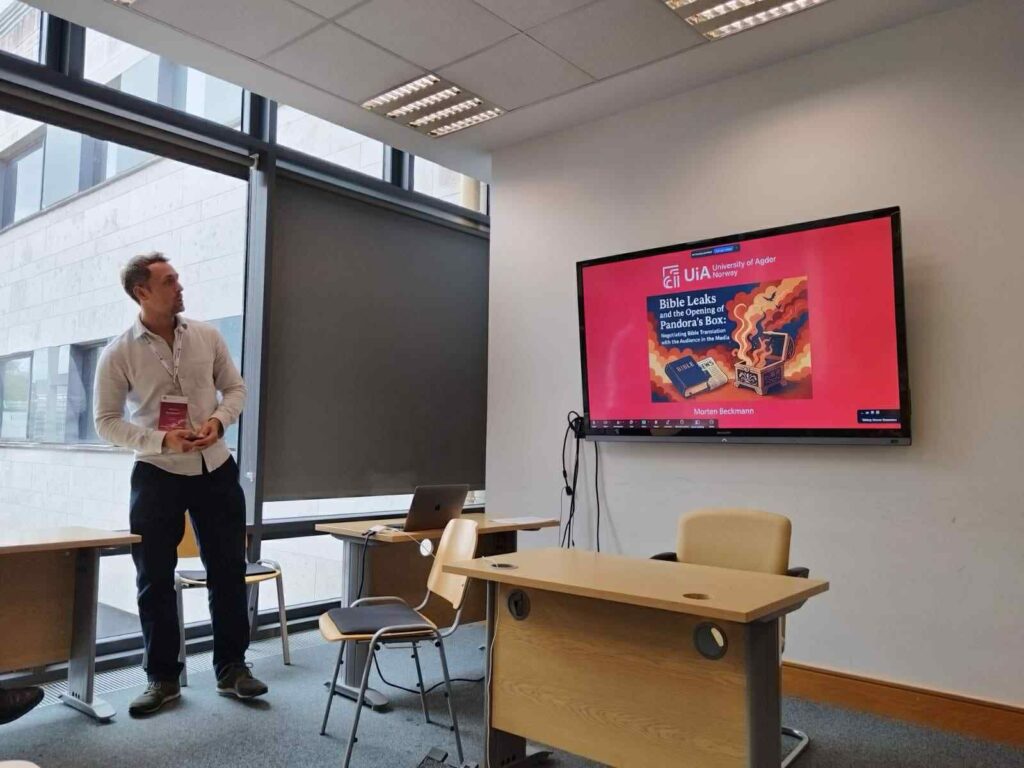
Earlier in September, Morten Beckmann participated in the international conference Trextuality 2. Material Turns in Translation: Intermediality and Circulation at the University of Galway, Ireland. The conference gathered scholars to explore how translation interacts with materiality, media, and circulation in contemporary contexts.
Morten’s presentation, titled “Bible Leaks and the Opening of Pandora’s Box: Negotiating Bible Translation with the Audience in the Media,” examined translation as a situated process within institutional structures, focusing on the Norwegian Bible Society and its recent release of Bibel 2024.
The talk analyzed how the draft translations was leaked to the media before publication, inviting audience feedback on changes such as gender-inclusive language and texts related to homosexuality and hell. While intended to foster dialogue, these leaks sparked intense public debate and accusations of “wokeness,” illustrating how consumer and media agency can influence institutional decision-making.
Drawing on New Framing Theory and an infrastructural lens, Morten highlighted how media framing amplified polarization and how the Protestant infrastructure—lacking a central ecclesiastical authority—both enables and constrains translation processes.
This case study sheds light on the complex interplay between translation, audience participation, and media dynamics, revealing how translation decisions are negotiated in public arenas rather than behind closed doors.
From the 8th to 10th of September, one member of our research group participated in the 8th edition of Using Corpora in Contrastive and Translation Studies at the University of Hildesheim, Germany. The conference aimed to bring together researchers and scholars working with corpus-based approaches in language and translation research.
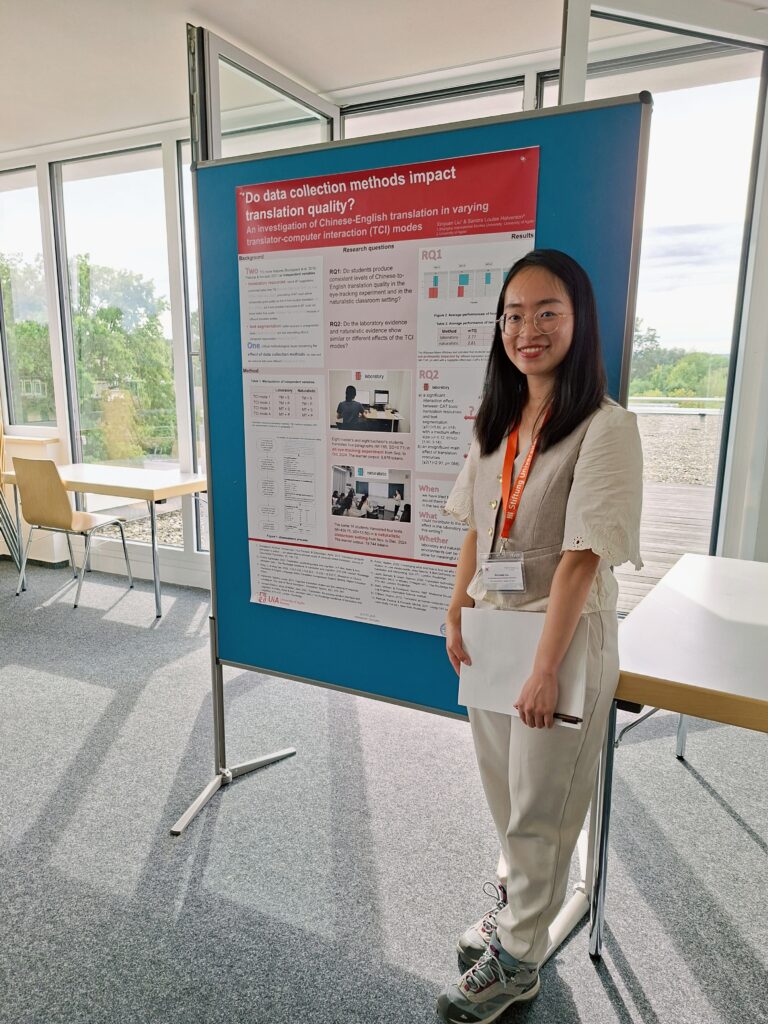
On the 9th of September, Xinyuan Liu delivered a poster presentation that focused on data triangulation, titled “Do data collection methods impact translation quality? An investigation of Chinese-English translation in varying translator-computer interaction modes”. She and her co-author, Sandra Halverson, investigated whether translation product data collected in laboratory and naturalistic settings demonstrated consistent translation quality and whether the effects of the independent variables were the same across different data collection environments.
Online Research Training Event 26 June – 9 July 2023
The 3nd International Research School for Media Translation and Digital Culture, organized by the Baker Centre for Translation and Intercultural Studies at Shanghai International Studies University (SISU), will take place from 26 June to 9 July 2023.
AFO member Prof. Luis Pérez-González has acted as Academic Director of SISU’s Media Research School since it was first launched in 2019.
The School aims to foster an open and wide-ranging take on media translation and digital culture, and to highlight the significance of both for and beyond translation studies. It encourages cross-fertilization between the two disciplinary sub-fields and addresses the new theoretical and methodological tools that translation scholars need in order to understand the strategic and catalyzing role played by translation in relation to a number of issues, including the following:
Reconfiguring the ecology of networked media – from mainstream news organizations to citizen journalism outlets; from printed written articles to multimodal assemblages; from professional reportage to amateur coverage of conflicts and natural disasters
(Re)producing shifting public discourses about cosmopolitanism, gender, nation, expertise, fandom or activism – among other core issues;
Developing more collaborative, participatory and deliberative processes of community formation, both online and on the ground;
Enabling disciplinary discourses and developments in the fields of multimodality, media sociology, cultural studies, journalism, globalization studies and critical theories of communication technology.
Like the highly successful 2021 edition, the 2023 edition will be run in virtual mode, using an advanced e-learning environment provided by SISU. This allows for the full range of activities normally included in the face-to-face delivery mode to be provided virtually, including teamwork and tutorials.
The featured theme for the third edition of the School is Translation and Sustainability in Media & Digital Culture.
Teaching staff delivering the 2023 edition of the School will include Luis Pérez-González (University of Agder), Mona Baker, Jonathan Evans, Henry Jones, Kyung Hye Kim and Neil Sadler.